MonoSpace / Manifesto · Vol. 01
First Principles
Five commitments behind every system the studio builds — and the older work they rest on.
Abstract
MonoSpace is a studio for commissioned digital systems. This document states the principles it works from. The name holds two ideas together: monospaced type, where every character is given an equal, countable cell, and negative space, where the empty field is treated as a material rather than a leftover. Structure and silence; signal and discipline. What follows is five principles and the older work they stand on.
01
Principle 01 / Observability
The only way to understand a system is to try and change it.
A system you cannot poke is a system you do not understand. Comprehension is not produced by reading a description of a thing; it is produced by perturbing the thing and watching what moves. So software should be built to be observed, measured, and changed — its internal state legible, its behaviour instrumented, its parts open to revision without ceremony.
This is an engineering stance before it is a philosophical one. Expose the signal. Make the quantities that matter measurable rather than asserted. Treat every interface as a place where a hypothesis can be tested, and build it so that changing one part teaches you something true about the whole.
Fig. 01 — Instrumented system / observable state deformation.test
Elastic
02
Principle 02 / Human Primacy
People are not cogs in machines.
Most software quietly assumes the opposite. It defines a process, then asks the human to file themselves into it: to memorise its order, absorb its vocabulary, and route around its omissions. The person becomes the adaptive layer that makes a rigid machine usable.
We invert that. Software should adapt to people; people should never be forced to adapt to software. That means leaving room — actual space — for how someone actually thinks and works, and tuning the system to the human rather than tuning the human to the system. The mix serves the listener, not the desk.
Software should serve people, not procurement departments. We do not build systems that turn people into tickets, metrics, or seats.
Fig. 02 — System organised around the person vector.field
Tracking
03
Principle 03 / Transparency
Software should never be a black box.
A black box asks for trust it has not earned. When the workings are hidden, the user cannot predict the system, cannot repair it, and cannot tell a fault from a feature. Opacity is not sophistication; it is usually just an undocumented decision wearing a confident face.
So every system should be understandable, and we explain ours deliberately — the architecture, the tradeoffs, and the reasoning behind them — in the open, the way a research group publishes its method and not only its conclusions. Structure that can be read is structure that can be trusted.
Fig. 03 — Exploded view / nothing concealed packet.routing
Forwarding
04
Principle 04 / Evidence
Decisions should be scientifically informed.
Taste has its place, but it is a poor substitute for measurement. Most disputes about software are settled by whoever speaks last or loudest. We would rather they be settled by what can be observed and reproduced.
Evidence before opinion.Measurement before marketing.Data before trends.
The discipline is borrowed wholesale from the sciences. A claim about how a system behaves should be checkable, and a decision that cannot survive contact with its own data is a decision we have not finished making. And we reject software that optimises the dashboard while making the work worse.
Fig. 04 — Measured distribution / claim under test signal.plot
Acquiring
05
Principle 05 / Scope
Software is larger than B2B SaaS.
It is easy to forget, inside the industry's gravity well, that software is not primarily a way to sell software. It runs inside far older and more serious endeavours.
- 01Medicine
- 02Science
- 03Education
- 04Engineering
- 05Government
- 06Manufacturing
- 07Research
- 08Exploration
- 09Music
- 10Art
These are the places where careful systems matter most, and where the discipline of instrumented, documented engineering was learned in the first place. Technology should enable human progress, not optimise an advertising funnel. MonoSpace would rather build the instrument than the funnel.
Fig. 05 — Trajectory beyond the funnel orbital.mechanics
Selective
References
Inspirations & sources.
Every claim above stands on older work. Hover or tap a citation to read its card; the full bibliography is set out below. Each entry links to the original source — never to an encyclopedia.

[1]Typography / Specimen
Monospaced Type
A letterform system in which every glyph occupies an identical horizontal cell. Inherited from the typewriter and the teletype, it turns a line of text into a measured grid where alignment is a property of the system rather than an accident of rendering.
RelationThe first half of the name. MonoSpace borrows the discipline of fixed pitch: structure you can count on, where things line up because the system guarantees it, not because someone nudged them.
Butterick’s Practical Typography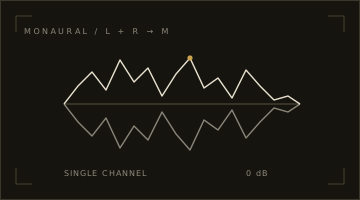
[2]Acoustics / Single Channel
The Mono Mix
Before stereo, a recording was balanced into a single channel. Every instrument shared one space, and the engineer had to decide what carried and what receded. There was nowhere to hide a weak part.
RelationMono is a constraint that forces clarity. One channel, no theatrics. MonoSpace prefers signal that survives being collapsed to a single, honest line.
Abbey Road Studios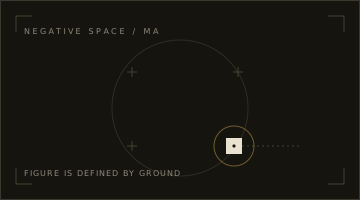
[3]Composition / Ma
Negative Space
The empty field is not absence. In Japanese design it is named — ma — and treated as an element in its own right: the interval that gives a mark its weight, meaning, and pace.
RelationThe second half of the name. Whitespace here is structural. It is used deliberately to slow the reader and let one idea stand clear of the next.
Nielsen Norman Group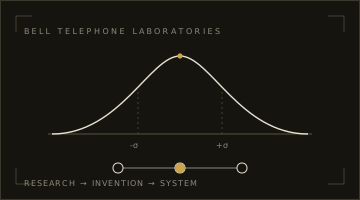
[4]Research / Institution
Bell Telephone Laboratories
The industrial research laboratory that produced the transistor, the laser, the solar cell, Unix, the C language, and information theory itself — patient science conducted inside an engineering company.
RelationThe standard MonoSpace measures itself against: rigorous, instrumented, unhurried work where the research and the product are the same activity.
Nokia Bell Labs
[5]Engineering / Exploration
NASA
Systems engineering under absolute constraint. Every subsystem is observable, every margin is measured, and every decision is documented, because failure cannot be patched after launch.
RelationEvidence of what software is really for. MonoSpace builds for domains where the interface is an instrument, not a funnel — places where being wrong has a cost.
NASA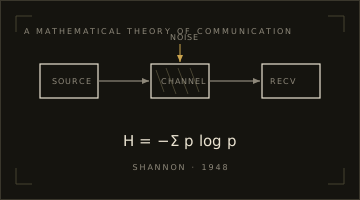
[6]Mathematics / 1948
A Mathematical Theory of Communication
Claude Shannon’s 1948 paper defined information, entropy, and the channel. It proved how much signal can pass through noise, and how little is actually needed to carry meaning.
RelationThe intellectual spine of the studio: separate signal from noise, and quantify the difference before deciding what is worth keeping.
C. E. Shannon — original paper (PDF)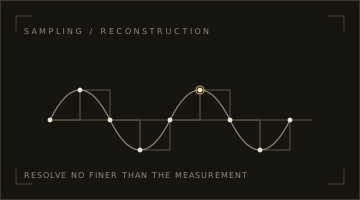
[7]Engineering / DSP
Signal Processing
Sampling, filtering, and transformation: the discipline of recovering a true signal from a measured one, and of knowing precisely the limits of what was captured.
RelationHow MonoSpace treats a brief. Sample reality carefully, filter the noise, and never claim a resolution finer than the measurement allows.
IEEE Signal Processing Society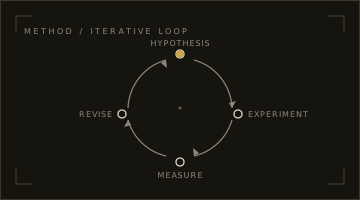
[8]Method / Epistemics
The Scientific Method
Hypothesis, experiment, measurement, revision. A discipline for being wrong slowly and on purpose, so that whatever survives the loop has actually been earned.
RelationThe way MonoSpace makes decisions: evidence before opinion, measurement before marketing, data before trends.
The Royal Society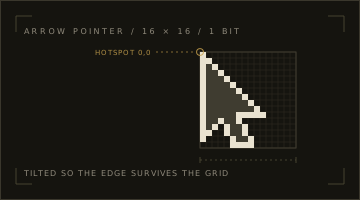
[9]Interface / Bitmap 1984
The Macintosh Cursor
The Macintosh cursor set was designed in 1984 by graphic designer Susan Kare for the first 128K Macintosh — the wristwatch, the I-beam, the pointing hand, each drawn cell by cell on a sixteen by sixteen grid. The tilted arrow itself is older, inherited from Xerox PARC by way of the Lisa, but the family it belongs to is hers.
RelationThe pointer on this site is that arrow redrawn cell by cell on a larger grid — not an upscale of the original, but the same construction at a size a modern screen can carry. The tilt was never a stylistic flourish: an upright arrow dissolves into the vertical pixel columns, so the shape was leaned over until its edge survived the raster. Constraint doing the design work, at a scale you can still count by hand.
Susan Kare — portfolio
Colophon
Set in IBM Plex Mono and Iowan Old Style. Composed on a twelve-column grid with deliberate negative space. Citations resolve to primary sources. This is Issue 01, and it is expected to be revised as the work teaches us where it was wrong.