MonoSpace / Manifesto · Issue 01 / References
References
Numbered marks point to evidence, argument, official data and historical sources. Lettered marks point to analogies, which are images, not evidence. Hover or tap a mark to read its card. Every entry links to the source itself, never to an encyclopedia, with a note on how much weight it can bear.
01
Research and studies
Empirical studies and reviews: the evidence the argument leans on most. Each record says how far it has been read. 39 sources.
The Effects of Generative AI on High-Skilled Work: Evidence from Three Field Experiments with Software Developers
WeightRead in full during the research review. Confidence: Medium-high.
Cited in01 / The cheap part
SourceManagement Science (published 2026); earlier SSRN 4945566 / MSR working paper June 2025 (opens in a new tab)How much does AI impact development speed? An enterprise-based randomized controlled trial
WeightRead in full during the research review. Confidence: Medium.
Cited in01 / The cheap part
SourcearXiv preprint (open access) (opens in a new tab)Measuring the Impact of Early-2025 AI on Experienced Open-Source Developer Productivity
WeightRead in full during the research review. Confidence: Medium.
Cited in01 / The cheap part
SourcearXiv preprint (METR) (opens in a new tab)We are Changing our Developer Productivity Experiment Design
WeightRead in full during the research review. Confidence: Medium.
Cited in01 / The cheap part
SourceMETR blog (opens in a new tab)Many SWE-bench-Passing PRs Would Not Be Merged into Main
WeightRead in full during the research review. Confidence: Medium-high.
Cited in01 / The cheap part
SourceMETR research note (opens in a new tab)How AI Impacts Skill Formation
WeightRead in full during the research review. Confidence: Medium.
Cited in01 / The cheap part
SourcearXiv preprint (Anthropic) (opens in a new tab)The rise and fall of the Chaos report figures
WeightRead in full during the research review. Confidence: High.
Cited in02 / The old part
SourceIEEE Software 27(1), 30-36 (opens in a new tab)A replicated survey of IT software project failures
WeightRead in full during the research review. Confidence: High (for rates); low (for causes).
Cited in02 / The old part
SourceIEEE Software 25(5), 84-90 (opens in a new tab)Waterfall and Agile information system project success rates - A South African perspective
WeightRead in full during the research review. Confidence: Medium.
Cited in02 / The old part05 / Between versions
SourceSouth African Computer Journal 32(1) (opens in a new tab)The empirical reality of IT project cost overruns: discovering a power-law distribution
WeightRead in full during the research review. Confidence: High.
Cited in02 / The old part
SourceJournal of Management Information Systems 39(3), 607-639 (opens in a new tab)Effectiveness of requirements elicitation techniques: empirical results derived from a systematic review
WeightOnly the abstract has been read; figures from it are still to be checked against the full text. Confidence: Medium.
Cited in03 / Distance to the knowledge
Source14th IEEE International Requirements Engineering Conference (RE'06), pp. 179-188 (opens in a new tab)A field study of the software design process for large systems
WeightRead in full during the research review. Confidence: Medium.
Cited in03 / Distance to the knowledge
SourceCommunications of the ACM 31(11):1268-1287 (opens in a new tab)Customer-developer links in software development
WeightRead in full during the research review. Confidence: Medium.
Cited in03 / Distance to the knowledge
SourceCommunications of the ACM 38(5):33-44 (opens in a new tab)The impact of culture on communication during user requirements gathering: a South African banking case study
WeightOnly the abstract has been read; figures from it are still to be checked against the full text. Confidence: Low.
Cited in03 / Distance to the knowledge
SourceMCom (Informatics) dissertation, University of Pretoria (opens in a new tab)A systematic review on the relationship between user involvement and system success
WeightRead in full during the research review. Confidence: High.
Cited in03 / Distance to the knowledge
SourceInformation and Software Technology 58, 148-169 (opens in a new tab)Rapid prototyping: lessons learned
WeightRead in full during the research review. Confidence: Medium.
Cited in05 / Between versions
SourceIEEE Software, 12(1), 85-95 (opens in a new tab)Parallel prototyping leads to better design results, more divergence, and increased self-efficacy
WeightRead in full during the research review. Confidence: Medium.
Cited in05 / Between versions
SourceACM Transactions on Computer-Human Interaction, 17(4), Article 18 (opens in a new tab)Getting the right design and the design right: testing many is better than one
WeightRead in full during the research review. Confidence: Medium-High.
Cited in05 / Between versions
SourceProceedings of CHI 2006, 1243-1252 (opens in a new tab)The XP customer role in practice: three studies
WeightRead in full during the research review. Confidence: Medium.
Cited in05 / Between versions
SourceAgile Development Conference 2004, pp. 42-54 (opens in a new tab)Managing the Sources of Uncertainty: Matching Process and Context in Software Development
WeightOnly the abstract has been read; figures from it are still to be checked against the full text. Confidence: Medium.
Cited in05 / Between versions
SourceJournal of Product Innovation Management 20(3):217-232 (opens in a new tab)Manipulating and measuring model interpretability
WeightRead in full during the research review. Confidence: Medium-high.
Cited in06 / The people responsible
SourceProceedings of CHI 2021, 1-52 (opens in a new tab)Does the whole exceed its parts? The effect of AI explanations on complementary team performance
WeightRead in full during the research review. Confidence: High.
Cited in06 / The people responsible
SourceProceedings of CHI 2021, 1-16 (opens in a new tab)Mental models and problem solving in using a calculator
WeightRead in full during the research review. Confidence: Low-medium (seven participants; descriptive results only).
Cited in06 / The people responsible
SourceProceedings of CHI '83 (SIGCHI Conference on Human Factors in Computing Systems), 212-216 (opens in a new tab)The impact of tutorials on games of varying complexity
WeightRead in full during the research review. Confidence: High (for games); Low-to-moderate for transfer to business software.
Cited in06 / The people responsible
SourceProceedings of the SIGCHI Conference on Human Factors in Computing Systems (CHI '12), Austin, TX (opens in a new tab)Investigating the Homogenization of Web Design: A Mixed-Methods Approach
WeightRead in full during the research review. Confidence: High (for what it measures).
Cited in07 / Rent, own, leave
SourceProceedings of the 2021 CHI Conference on Human Factors in Computing Systems (CHI '21), ACM (opens in a new tab)Small World with High Risks: A Study of Security Threats in the npm Ecosystem
WeightRead in full during the research review. Confidence: High.
Cited in07 / Rent, own, leave
SourceProceedings of the 28th USENIX Security Symposium, USENIX Association (paper begins p. 995; end page not verified) (opens in a new tab)Cloud Computing and Firm Growth
WeightOnly the abstract has been read; figures from it are still to be checked against the full text. Confidence: High.
Cited in07 / Rent, own, leave
SourceReview of Economics and Statistics, 107(6), 1638-1651 (opens in a new tab)Economies Before Scale: I.T. Strategy and Performance Dynamics of Young U.S. Businesses
WeightRead in full during the research review. Confidence: High.
Cited in07 / Rent, own, leave
SourceManagement Science, 71(9), 7449-7473 (opens in a new tab)A Novel Approach for Estimating Truck Factors
WeightRead in full during the research review. Confidence: Medium.
Cited in07 / Rent, own, leave
SourceProceedings of the 24th IEEE International Conference on Program Comprehension (ICPC 2016) (opens in a new tab)The evolution of the laws of software evolution: A discussion based on a systematic literature review
WeightRead in full during the research review. Confidence: High.
Cited in08 / After launch
SourceACM Computing Surveys 46(2), Article 28 (opens in a new tab)Do developers update their library dependencies? An empirical study on the impact of security advisories on library migration
WeightRead in full during the research review. Confidence: Medium-High.
Cited in08 / After launch
SourceEmpirical Software Engineering 23(1): 384-417 (opens in a new tab)On the abandonment and survival of open source projects: An empirical investigation
WeightRead in full during the research review. Confidence: Medium.
Cited in08 / After launch
SourceProceedings of ACM/IEEE ESEM 2019 (opens in a new tab)Cogs in the machine: The prioritization of money and self-dehumanization
WeightRead in full during the research review. Confidence: Medium (for the narrow lab finding); low (for any workplace generalisation).
Cited in · corrected09 / Not cogsCorrections to earlier drafts
SourceOrganizational Behavior and Human Decision Processes, 149, 47-58 (opens in a new tab)The effect of financial incentives on performance: A quantitative review of individual and team-based financial incentives
WeightOnly the abstract has been read; figures from it are still to be checked against the full text. Confidence: High.
Cited in09 / Not cogs
SourceJournal of Occupational and Organizational Psychology, 87(1), 102-137 (opens in a new tab)(Still) Modern Times: Objectification at work
WeightOnly the abstract has been read; figures from it are still to be checked against the full text. Confidence: Medium.
Cited in09 / Not cogs
SourceEuropean Journal of Social Psychology, 47(1), 25-35 (opens in a new tab)Hybrid software and system development in practice: waterfall, scrum, and beyond
WeightRead in full during the research review. Confidence: Medium.
Cited in10 / What we do about it
SourceProceedings of the 2017 International Conference on Software and System Process (ICSSP), pp.30-39 (opens in a new tab)Towards an Anatomy of Software Craftsmanship
WeightRead in full during the research review. Confidence: Medium.
Cited in10 / What we do about it
SourceACM Transactions on Software Engineering and Methodology, 31(1), Article 6 (January 2022), 1-49 (opens in a new tab)What Is Beautiful Is Usable
Tractinsky, Katz and Ikar tested how an interface’s look relates to how usable people judge it, using a simulated cash machine. Perceived beauty and perceived usability were strongly correlated, and after people had used the system, its aesthetics still shaped their judgement of its usability while its actual usability did not. It is one experiment on one kind of interface, so it is a reason for caution, not a law.
RelationListed in the corrections: an earlier draft cited this study for “a good-looking interface can pass for a working one”, but it measured perceived usability, not whether interfaces worked.
Cited in · correctedCorrections to earlier drafts
SourceN. Tractinsky, A. S. Katz, D. Ikar, Interacting with Computers 13(2), 2000 (opens in a new tab)Causal Inference in Statistics: An Overview
Judea Pearl’s survey of the mathematics of cause and effect. It separates analysis under unchanged conditions from analysis of what happens when conditions change, for example under an intervention. There is nothing in the joint distribution of symptoms and diseases to tell us that curing one would cure the other. That knowledge has to be supplied by causal assumptions.
RelationListed in the corrections: the overview does not say that you cannot understand a system until you have tried to change it.
Cited in · correctedCorrections to earlier drafts
SourceJ. Pearl, Statistics Surveys 3, 2009 (opens in a new tab)
02
Official reports, statistics and regulation
Government statistics, audit reports, law and industry surveys, cited for facts about the setting rather than for argument. 14 sources.
State of AI-assisted Software Development 2025
WeightOnly the abstract has been read; figures from it are still to be checked against the full text. Confidence: Medium.
Cited in01 / The cheap part
SourceDORA / Google Cloud (opens in a new tab)Consolidated General Report on National and Provincial Audit Outcomes 2024–25 (PFMA)
The Auditor-General of South Africa’s consolidated report on national and provincial audit outcomes for 2024–25. On page 100 it reports evaluating 72 ICT projects, with findings on 41 of them, with a combined project value of R12.1 billion, across 23 of the 44 auditees. A finding is not the same as a project that has conclusively failed, and the combined value is not a measured loss.
RelationSection 02’s local evidence that public-sector software goes wrong for ordinary, organisational reasons.
WeightChecked against the primary source on 12 October 2026 for the claims cited here.
Cited in02 / The old part
SourceAuditor-General of South Africa, 2025, page 100 (PDF page 104) (opens in a new tab)General Household Survey 2024
Statistics South Africa’s annual household survey. In 2024, just over a third of households reported a power interruption in the week before they were surveyed.
RelationA reminder in section 04 that national load-shedding statistics are not the whole story: households still met interruptions after load-shedding eased.
WeightChecked against the primary source on 12 October 2026 for the claims cited here.
Cited in04 / Who, not where
SourceStatistics South Africa, Statistical release P0318 (2025) (opens in a new tab)Utility-scale power generation statistics in South Africa 2024
The CSIR Energy Centre’s annual statistics on South Africa’s utility-scale power generation. It estimates load-shedding in 2023 at 6,948 hours.
RelationThe peak against which section 04 measures how quickly power conditions changed. Its data covers 2023 and 2024, so the 2025 return is cited separately to Eskom.
WeightChecked against the primary source on 12 October 2026 for the claims cited here.
Cited in04 / Who, not where
SourceCSIR Energy Centre, statistics report for 2024 (published 2025) (opens in a new tab)Eskom’s Winter 2025 power system outlook
Eskom’s outlook for winter 2025, published on 5 May 2025. It notes that winter 2024 had no load-shedding, and records “recent loadshedding requirements between January to April 2025”.
RelationThe source for section 04’s statement that load-shedding returned briefly in 2025. It is cited apart from the CSIR figures, which stop at 2024.
WeightChecked against the primary source on 12 October 2026 for the claims cited here.
Cited in04 / Who, not where
SourceEskom media statement, 5 May 2025 (opens in a new tab)Protection of Personal Information Act 4 of 2013, section 72
Section 72 of POPIA sets the conditions under which personal information may be transferred to a third party in a foreign country.
RelationWhy section 04 treats where data lives as a choice with conditions attached, not a ban on hosting abroad.
WeightChecked against the primary source on 12 October 2026 for the claims cited here.
Cited in04 / Who, not where
SourceProtection of Personal Information Act 4 of 2013, official text (gov.za) (opens in a new tab)South African Rand to U.S. Dollar Spot Exchange Rate [DEXSFUS]
WeightRead in full during the research review. Confidence: High (for rates).
Cited in04 / Who, not where
SourceFRED economic data (H.10 release), retrieved 2026-09-28 (opens in a new tab)Review of the Summer 2023 Microsoft Exchange Online Intrusion (20 March 2024)
WeightRead in full during the research review. Confidence: High.
Cited in07 / Rent, own, leave
SourceCISA / DHS (opens in a new tab)Cloud services market investigation: Summary of final decision (31 July 2025)
WeightRead in full during the research review. Confidence: High.
Cited in07 / Rent, own, leave
SourceCMA, UK Government (opens in a new tab)Regulation (EU) 2023/2854 (Data Act), Article 29
Article 29 of the EU Data Act provides for the gradual withdrawal of switching charges. From 12 January 2027, providers of data-processing services within the Regulation’s scope may not impose switching charges.
RelationSection 07’s example of a regulator acting on the cost of leaving, the part of lock-in that matters most. It removes the charges, not the work of moving.
WeightChecked against the primary source on 12 October 2026 for the claims cited here.
Cited in07 / Rent, own, leave
SourceOfficial Journal of the European Union, Regulation (EU) 2023/2854 (opens in a new tab)SARS 2024/25 Annual Report (RP160/2024)
WeightRead in full during the research review. Confidence: Medium.
Cited in08 / After launch
SourceSARS annual report (tabled in Parliament) (opens in a new tab)Review of the December 2021 Log4j Event
WeightRead in full during the research review. Confidence: High.
Cited in08 / After launch
SourceCSRB report, 11 July 2022 (opens in a new tab)Information Technology: Agencies Need to Plan for Modernizing Critical Decades-Old Legacy Systems (GAO-25-107795)
WeightRead in full during the research review. Confidence: High.
Cited in08 / After launch
SourceGAO report, 17 July 2025 (opens in a new tab)State of South Africa's Software Developer Nation 2025
WeightRead in full during the research review. Confidence: Medium-low.
Cited in09 / Not cogs
SourceOfferZen (industry report, web) (opens in a new tab)
03
Historical and technical references
Foundational arguments, historical documents, technical standards, practitioner writing, company accounts and press reports. 23 sources.
Government wasted R12 billion on failing IT systems
WeightRead in full during the research review. Confidence: Low (as evidence); useful as example of statistic drift.
Cited in02 / The old part
SourceMyBroadband (opens in a new tab)No Silver Bullet: Essence and Accidents of Software Engineering
Fred Brooks argued that the hardest single part of building a software system is deciding precisely what to build, and that it is really impossible for a client, even working with a software engineer, to specify the exact requirements of a modern product before trying some versions of it. His remedy was extensive iteration between client and builder, with prototypes as the working instrument.
RelationThe reason MonoSpace works in two ways. A brief that can be specified in advance can be built fast and exactly. A brief that cannot has to be discovered, and discovery takes observation, exploration, feedback, and the client in the room.
Cited in02 / The old part
SourceF. P. Brooks Jr., IEEE Computer 20(4), 1987 (opens in a new tab)Requirements that handle IKIWISI, COTS, and rapid change
WeightRead in full during the research review. Confidence: Medium (as expert opinion).
Cited in03 / Distance to the knowledge
SourceComputer (IEEE) 33(7): 99-102 (opens in a new tab)Microsoft opens first datacenters in Africa with general availability of Microsoft Azure
Microsoft’s announcement of Azure regions in South Africa, its first datacentres on the continent.
RelationOne of the three in-country cloud regions behind section 04’s point that hosting location is now a choice for more projects.
WeightChecked against the primary source on 12 October 2026 for the claims cited here.
Cited in04 / Who, not where
SourceMicrosoft Azure blog, 2019 (opens in a new tab)Announcing the new AWS Africa (Cape Town) Region
Amazon Web Services’ announcement of its Africa (Cape Town) region.
RelationOne of the three in-country cloud regions behind section 04’s point that hosting location is now a choice for more projects.
WeightChecked against the primary source on 12 October 2026 for the claims cited here.
Cited in04 / Who, not where
SourceAmazon Web Services, 2020 (opens in a new tab)Heita South Africa! Our new Johannesburg cloud region is now open
Google Cloud’s announcement that its Johannesburg cloud region is open.
RelationOne of the three in-country cloud regions behind section 04’s point that hosting location is now a choice for more projects.
WeightChecked against the primary source on 12 October 2026 for the claims cited here.
Cited in04 / Who, not where
SourceGoogle Cloud blog, 2024 (opens in a new tab)Managing the development of large software systems
WeightRead in full during the research review. Confidence: High (for what the paper says); Low as evidence of effect.
Cited in05 / Between versions
SourceProceedings, IEEE WESCON, August 1970, pp. 1-9 (opens in a new tab)On the criteria to be used in decomposing systems into modules
WeightRead in full during the research review. Confidence: High.
Cited in06 / The people responsible
SourceCommunications of the ACM 15(12), 1053-1058 (opens in a new tab)Ironies of Automation
Lisanne Bainbridge examined how automating industrial processes can enlarge rather than remove the problems of the human operator. The designer who tries to eliminate the operator still leaves the operator the tasks the designer cannot think how to automate, so the person can be left with an arbitrary collection of tasks and little support for them.
RelationThe failure MonoSpace is trying not to build. When a system cannot handle something, a person absorbs it. We design the person’s part deliberately, instead of inheriting whatever the automation left over.
Cited in06 / The people responsible
SourceL. Bainbridge, Automatica 19(6), 1983 (opens in a new tab)The Origins of Pattern Theory: The Future of the Theory, and the Generation of a Living World
WeightRead in full during the research review. Confidence: High.
Cited in07 / Rent, own, leave
SourceIEEE Software 16(5), 71-82 (opens in a new tab)HAFNIUM targeting Exchange Servers with 0-day exploits (Microsoft Security Blog, 2 March 2021)
WeightRead in full during the research review. Confidence: Medium.
Cited in07 / Rent, own, leave
SourceMicrosoft Security Blog (opens in a new tab)Programs, life cycles, and laws of software evolution
WeightRead in full during the research review. Confidence: High for Law I as a general observation; low for the 70% figure.
Cited in08 / After launch
SourceProceedings of the IEEE 68(9): 1060-1076 (opens in a new tab)The dimensions of maintenance
WeightRead in full during the research review. Confidence: High (as typology origin).
Cited in08 / After launch
SourceProceedings of the 2nd International Conference on Software Engineering (ICSE '76), IEEE Computer Society (opens in a new tab)Programming as theory building
WeightRead in full during the research review. Confidence: High (for what the essay says); Low as evidence.
Cited in08 / After launch
SourceMicroprocessing and Microprogramming, 15(5), 253-261; reprinted in Naur, Computing: A Human Activity (1992) and as Appendix B of Cockburn, Agile Software Development (opens in a new tab)“Improving Ratings”: Audit in the British University System
Marilyn Strathern’s study of audit in British universities, widely credited as the source of the now common formulation of Goodhart’s law: when a measure becomes a target, it ceases to be a good measure.
RelationThe limit on measurement-first thinking. A metric is a claim about something we care about, and it stops being reliable once it is optimised for its own sake. MonoSpace treats numbers as evidence to interpret, not targets to hit.
Cited in09 / Not cogs
SourceM. Strathern, European Review 5(3), 1997 (opens in a new tab)The SPACE of developer productivity
WeightRead in full during the research review. Confidence: Medium-high.
Cited in09 / Not cogs
SourceCommunications of the ACM, 64(6), 46-53 (also ACM Queue 19(1), 20-48) (opens in a new tab)A Framework for the Comparative Analysis of Organizations
WeightRead in full during the research review. Confidence: Medium.
Cited in10 / What we do about it
SourceAmerican Sociological Review 32(2):194-208 (opens in a new tab)The Nature and Art of Workmanship
WeightRead through a secondary source; still to be checked against the original. Confidence: Medium.
Cited in10 / What we do about it
SourceCambridge University Press (opens in a new tab)Creativity, Generative AI, and Software Development: A Research Agenda
WeightRead in full during the research review. Confidence: Medium.
Cited in10 / What we do about it
SourcearXiv preprint 2406.01966 (v1, 4 June 2024) (opens in a new tab)Online Experimentation at Microsoft
Kohavi and colleagues at Microsoft report what happened when ideas were evaluated with controlled experiments: only about one third improved the metrics they were designed to improve. They note that success rates below 50% are reported across the software industry, and that there is some bias, because experiments tend to be run when teams are less sure about an idea, though they suggest it may be smaller than most people think.
RelationListed in the corrections: an earlier draft attributed to this paper a sentence, that tested ideas had already passed internal review, which it does not contain.
Cited in · correctedCorrections to earlier drafts
SourceR. Kohavi et al., Microsoft ThinkWeek paper, 2009 (PDF) (opens in a new tab)The Macintosh Cursor
In the classic Mac OS a cursor is a 256-pixel black-and-white image, sixteen by sixteen, with one designated hot spot that does the pointing. Susan Kare, who designed icons for the original Macintosh on a grid of squares that toggled from black to white, says the arrow already existed when she started, and describes cursor work as constraint: with one hot pixel, they tried different shapes until they worked and were easy to aim with.
RelationThe pointer on this site is that arrow redrawn cell by cell on a larger grid, not an upscale of the original. Inside Macintosh says a selection cursor should remain black, with a one-pixel outline in a contrasting colour where the hot spot must stay visible. The outline rule is for cursors over similarly coloured backgrounds. On the dark theme the bitmap is inverted rather than held literally.
Cited in · correctedCorrections to earlier drafts
SourceInterview with Susan Kare, Stanford University Libraries, 2000 (opens in a new tab)SourceInside Macintosh: About the Cursor, Apple (opens in a new tab)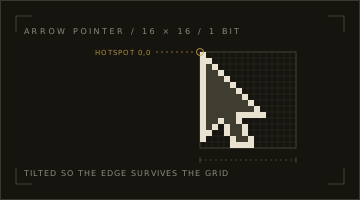
Negative Space
Arata Isozaki curated the exhibition MA: Space-Time in Japan in Paris in 1978, and it travelled on to New York, Houston, Chicago, Stockholm and Helsinki. The exhibition record does not define the Japanese word ma (間).
RelationThe second half of the name. Whitespace here is structural rather than decorative. It is used deliberately to slow the reader and let one idea stand clear of the next.
Cited in · correctedCorrections to earlier draftsColophon
SourceArt Platform Japan, MA: Space-Time in Japan (exhibition record) (opens in a new tab)
Monospaced Type
A typeface in which every glyph is the same width. Butterick’s Practical Typography traces monospaced fonts to the mechanical requirements of the typewriter, recommends them for two jobs, aligning columns of figures and setting software code, and advises against them in body text.
RelationThe first half of the name. MonoSpace borrows the discipline of fixed pitch: things line up because the system guarantees it, not because someone nudged them. We follow Butterick’s two exceptions in spirit, using mono for labels, figures and notation, where alignment carries meaning, and setting the reading text in a proportional face.
Cited inColophon
SourceButterick’s Practical Typography (opens in a new tab)
04
Cultural references and analogies
Stories and images used to make a point. They are cited with letters rather than numbers because they carry no evidential weight. 3 sources.
The Feeling of Power
WeightAn analogy, not evidence. Read in full during the research review. Confidence: High.
Cited in01 / The cheap part
SourceIf: Worlds of Science Fiction, February 1958; repr. Nine Tomorrows (1959) (opens in a new tab)Inside The Pixar Braintrust (excerpt from Creativity, Inc., with Amy Wallace)
WeightAn analogy, not evidence. Read in full during the research review. Confidence: Medium.
Cited in05 / Between versions
SourceFast Company, 12 March 2014 (read via Wayback Machine capture of 22 Nov 2025) (opens in a new tab)The Machine Stops
WeightAn analogy, not evidence. Read in full during the research review. Confidence: High.
Cited in08 / After launch
SourceThe Oxford and Cambridge Review, November 1909 (opens in a new tab)